
The Fulgor Nocturnus
Thoughts on pens, value systems, and form following function.


In 2020, the Fulgor Nocturnus by Tibaldi sold for $8 million at auction in Shanghai. It was not only the world’s most expensive pen, but the rarest. There is only one Fulgor Nocturnus, its extravagance barely eclipsed by its scarceness.
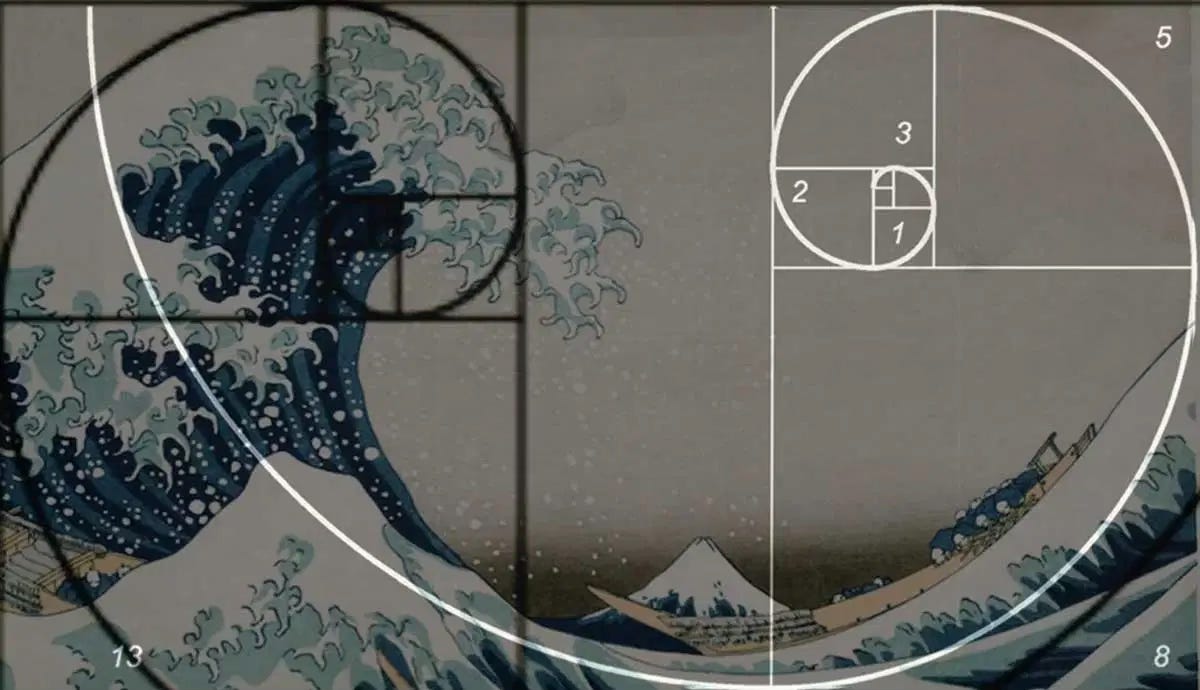
The Fulgor Nocturnus’ structure and design is based on the Phi ratio, also known as the Divine Proportion or the Golden Ratio. This special number (approximately 1.618) is in the pattern of tree branches and the spirals of sea-shells; it’s also in the works of Hokusai and Leonardo da Vinci. We intuitively perceive the Phi Ratio as structural harmony, a geometric design of spatial awareness that our subconscious recognizes as aesthetically pleasing. It draws as much from natural occurrences of symmetry, such as pine cones, as from mathematical constructs, such as the Fibonacci sequence. Its appeal is embedded within all human creations throughout time: sculptures, architecture, and yes, even pens.
When closed, the ratio between the cap and the visible portion of the barrel of the Fulgor Nocturnus pen is exactly 1.618. It doesn’t hurt that the Fulgor Nocturnus is also encrusted with nine hundred and forty-five black diamonds and one hundred and twenty-three rubies, with an eighteen-carat gold nib. If its flawless dimensions fail to catch your eye, its dazzling exterior certainly will.
I’ve never written with the Fulgor Nocturnus, and I probably never will. I’m sure it’s a great pen, and as a fan of pens, I can’t help but be in awe of its sheer audacity. Sure, it’s gaudy and excessive, but taking something as prosaic as a fountain pen and elevating it to rare, one-of-a-kind status symbol nonetheless piques my interest. And even more interesting than an $8 million pen is the type of person who buys one. Although the buyer of the Tibaldi Fulgor Nocturnus is unknown, I can guarantee you one thing: they’re not a writer.
How do I know this? Well, for one, most writers don’t have $8 million lying around. And even if they did, it wouldn’t be spent on a pen. While a pen is necessary to a writer’s vocation, it’s simply a tool — a way to telegraph thoughts in the head into words on a page. Whether you use a BIC ballpoint stick pen (which retails in packs of ten for about $1.59) or the Fulgor Nocturnus, the pen does not make the words on the page any better or worse. Sure, the quality of the ink and the precision of the tip can make the words appear crisper and more fluent, but the words themselves do not come from the pen. They come from the writer holding it.
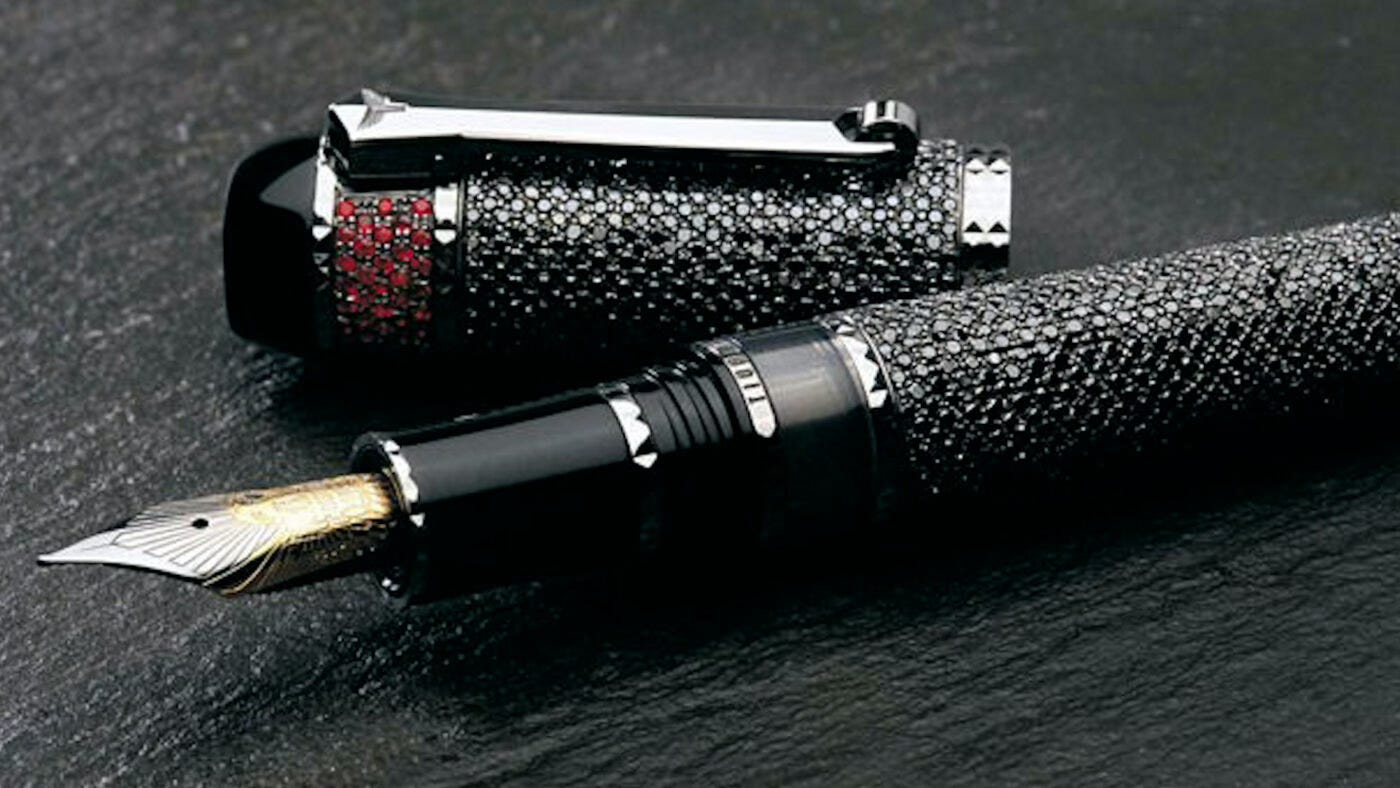
I’ve always struggled with things like the Fulgor Nocturnus because I’m of two minds about it. On the one hand, I have an affinity for expert craftsmanship, whether it be a pen, a chair, a pair of jeans, or a piece of sushi. I’m also grateful that beautiful objects exist, however exorbitant they may be. On the other hand, I hate frivolous things with unnecessary accoutrements — indulgence for the sake of indulgence.
When thinking about things like the Fulgor Nocturnus, I always go back to architect Louis Sullivan’s principle of “form follows function.” Sullivan’s rule has broad application across all practical and artistic endeavors: design should be dictated by intended use, with aesthetics secondary to usability. Ideally, true beauty should arise from functionality itself, rather than from added ornamentation. Practicality and efficiency outshine style and appendages.
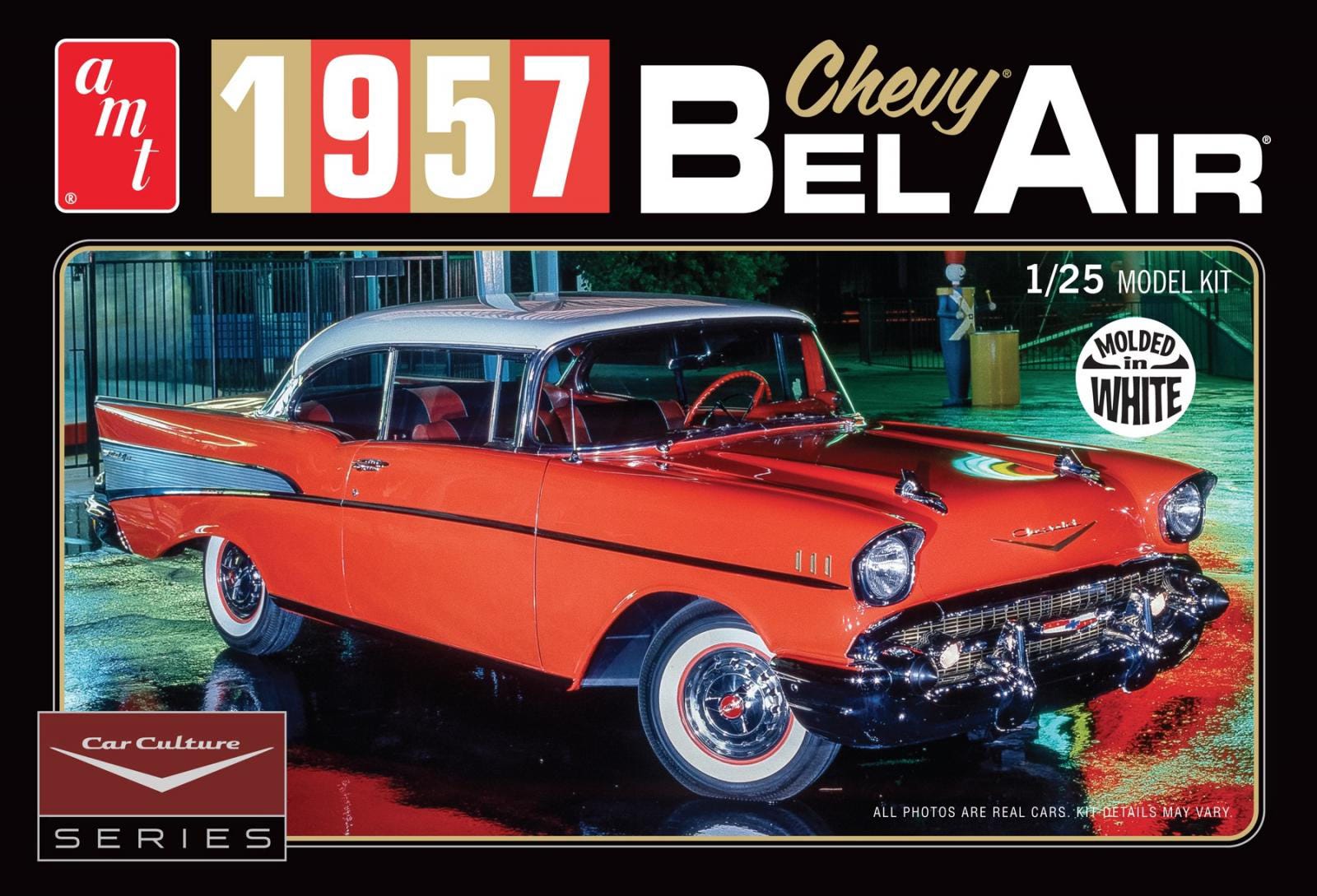
However, in the same breath that I regale in Sullivan’s philosophy, I can’t help but think about my love of midcentury American cars — the flamboyant tail fins, the abundant chrome, the jet-age influence of the aerospace industry on the automotive industry, resulting in vehicles that resembled rocket ships. The form of 1950s cars superseded function, and instead of being a practical piece of machinery, cars became emblematic of luxury and status. These midcentury relics serve the same purpose as any vehicle — to get you from point A to point B — and, encased within their lavish design, are the same kinds of engines as any other car on the highway. Their very essence is in contrast to Sullivan’s principle. And while their form may override their function, they just look so damn cool.
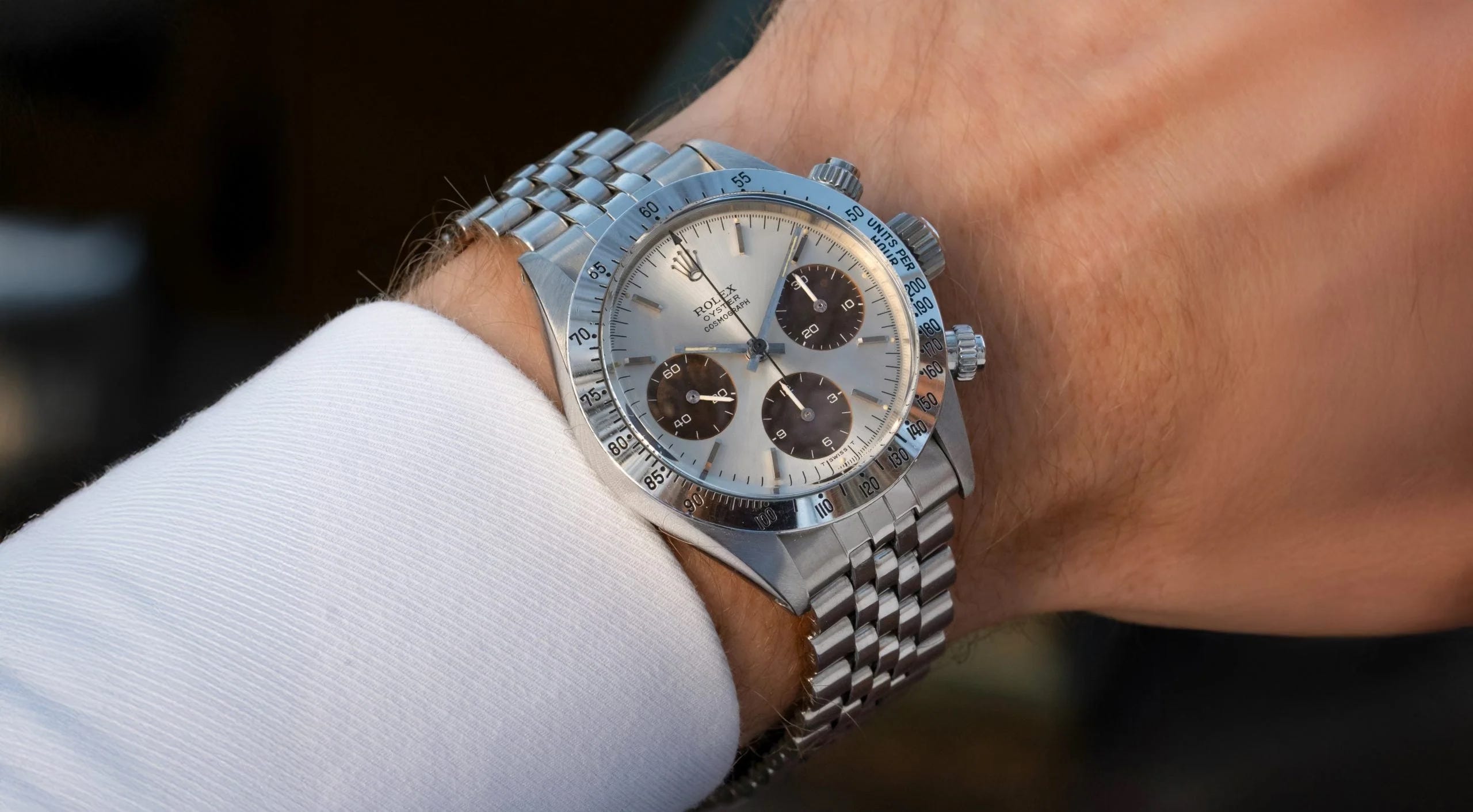
I also think about watches, specifically wristwatches. Their job is simple: to tell the time. That is their primary function, yet their form often rescinds their functionality. Watches are more akin to trophies; they communicate wealth and affluence rather than the time of day. There are whole brands devoted to the watch as a haute-couture symbol: Rolex, Cartier, and Patek Philippe. The essential function of the Rolex Daytona (which has a five-figure price tag) is the same as a Timex Reader, which retails for around $40-$60 and tells time just as well for a fraction of the cost.
Being a “gear-head” is part of the collateral damage of playing music. I’m not nearly as well-versed as other musicians I know — those who spend hours scouring over Reverb listings and can name every version of the Big Muff pedal ever released by Electro-Harmonix. However, over time, I’ve learned the general vocabulary and marketplace associated with instruments.
Perhaps the most ubiquitous guitar model next to the Gibson Les Paul is the Fender Stratocaster. Depending on the model, they can retail anywhere from a few hundred to tens of thousands. I recently came across a 1954 Fender Stratocaster listed for $200,795, which is…well, fucking crazy. But like any other vintage artifact, you’re not just buying a guitar — you’re buying a piece of history. The inflated price tag accounts not just for the guitar itself but also for the archival context surrounding it.
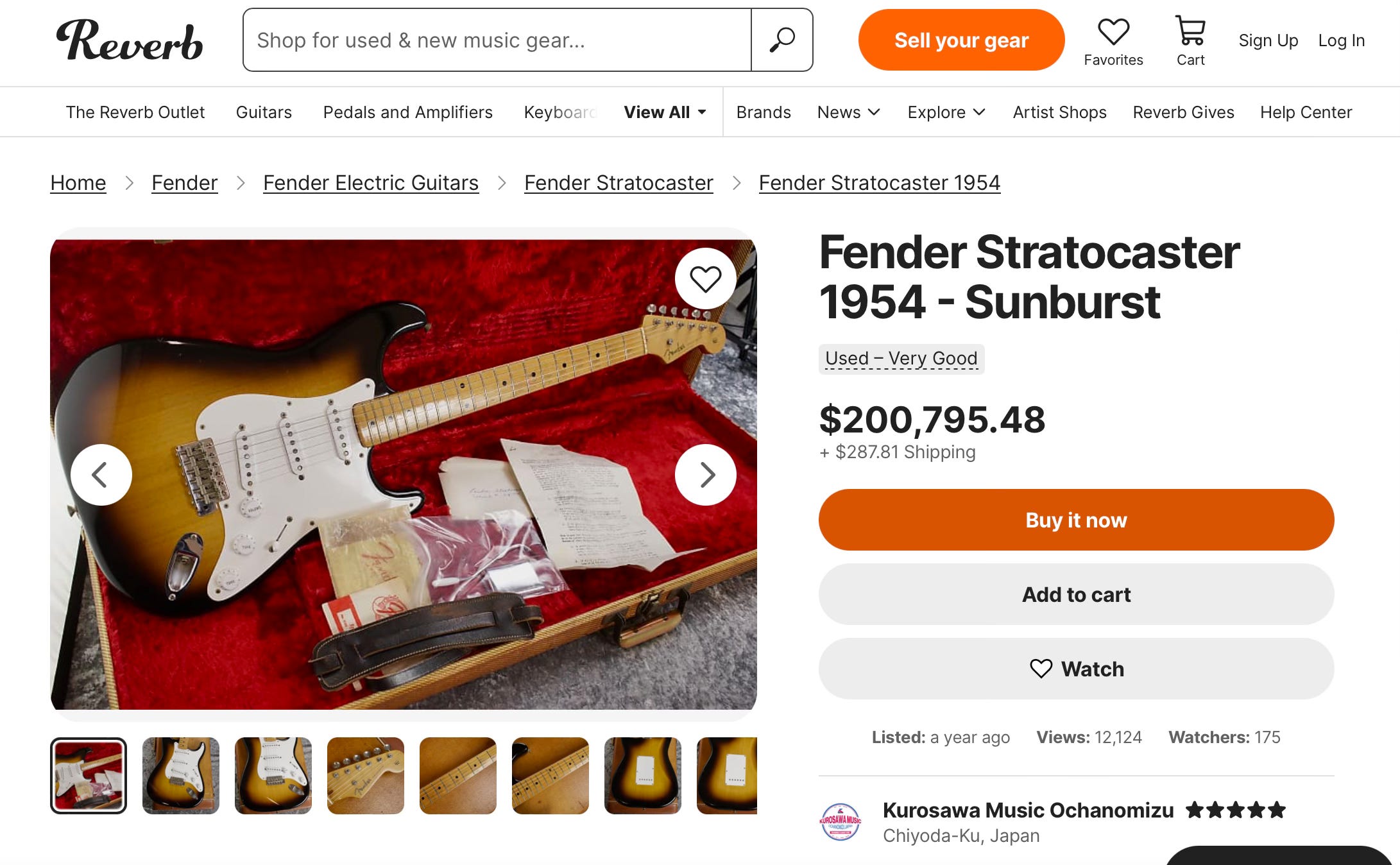
But a 1954 Fender Stratocaster that costs hundreds of thousands has the same basic function as a Fender Squier Stratocaster that costs just over a hundred dollars — it’s a guitar to be played. The same chords and melodies you play on the ‘54 Strat can also be played on the Squier model. Granted, those chords and melodies may sound better on the ‘54 Strat due to the quality of parts, but the guitar itself won’t make you a more proficient guitarist.
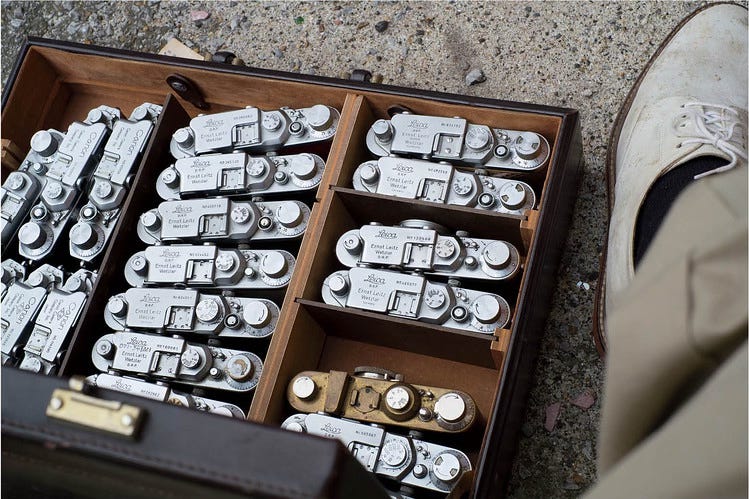
The same goes for photography, another gear-centric interest of mine. Cameras and lenses can be insanely expensive; some camera brands, such as Leica and Hasselblad, carry an air of superiority that’s embedded in their price tags. And while certain cameras and lenses will give you better exposures on the technical front — sharper images, deeper contrasts — they won’t change your subject matter or how you choose to frame it, which is the heart and soul of taking photos.
Parsed down to their most elemental function, all cameras do the same thing: they freeze a moment in time into a still image. Whether that image was taken on Leica M11-D Rangefinder (which retails for just over $10,000 without lenses) or on a disposable camera may change the resolution, but it doesn’t change your choice of perspective. The camera, the instrument, the watch, the car, the pen — these are all just functional tools. Often, I find myself considering whether their valuation stems more from their function or from their form.
I believe much of the delineation between form and function stems from our own personal value system. I’m sure someone who doesn’t value stereo gear as much as I do would be disgusted to learn how much I’d be willing to spend on a turntable. After all, the function of the turntable is to spin the record and play it. Regardless of whether it is an Audio-Technica LP-60 or a Technics SL-1200, every turntable does the same thing. But if you place value on your hi-fi system and audio fidelity, the functionality of your turntable is a consideration that’s given as much weight as its form.
I have a few friends who have fallen down the “watch rabbit-hole,” which I consider one of many aftershocks of dudes slipping into middle age: becoming fascinated with World War II, Steely Dan tunes slipping into playlists, building a small collection of wristwatches, etc. I have yet to enter the “watch-phase” of my life, so for the time being, I only consider their functionality. But my friends who value watches obsess over their form, justifying their costly prices by describing their high-quality materials, complex parts, and exclusivity.
When I consider my own value system for objects, a few key factors always resonate with me: craftsmanship, character, and history. But even more so, the number one aspect I value most is possibilities and inspiration. To articulate what I mean by that, I’ll go back to a few previous examples I’ve mentioned.
The photos I take with an old Polaroid camera are very different from the photos I take with a new digital Nikon. The function of both devices is the same, but given their form, I’m inspired to capture different types of images I usually wouldn’t gravitate towards without that specific camera. Through their particular lenses, I see the world around me differently, and with this new perspective, the possibility of capturing exposures I wouldn’t have otherwise considered presents itself.
Similarly, whenever I’m looking at guitars, I’m not so much concerned with the manufacturing year or the kind of pickups as I am with the thought, “What kind of songs are inside this guitar?” Just as cameras will make you take different types of photos, guitars will make you play differently. Whenever I play a hollow-body Gretsch, I loosen up my touch and voice jazzier chords. While playing in this mode, I’ll stumble across chord progressions or melodies I wouldn’t have played if I were playing a Gibson Explorer or a Fender Jaguar. Sometimes these chords and lead lines become songs — songs that wouldn’t have been written if I weren’t first inspired to play a certain way because of the guitar.
This brings me back to pens. I know when many people walk into office supply stores, they’re usually bummed out. Nine times out of ten, the reason for such a trip means you’re going back to school, or you have an upcoming work project — boring, dreary stuff. But for me, office supply stores have always been an exciting place to visit because they sell more than just paper and pencils — they sell possibilities. What will I write with this pen? What thoughts will I fill this notebook with? These tools all serve similar functions, but depending on their form, however trivial it may be — the color of the notebook, the ink in the pen — I might write something I otherwise wouldn’t have with a different set of office supplies.
As someone who writes, I value things like notebooks and pens beyond their functionality, which is why I’m inclined to admire their form and spend a bit more on them. Of course, not $8 million more, but a reasonable amount more. I know they won’t make me a better writer, but they may inspire me to write differently, or to write at all (it’s shocking how much of writing is spent procrastinating writing).
This is all to say that I believe our appreciation of the form and function of any given object depends upon where it aligns with our own value system, which is something that, amongst many other things, I’ve been pondering recently.
What kind of objects do you value most, and how much emphasis do you place on their function vs. their form when considering their valuation? Feel free to sound off in the comments.
As always, thank you for reading. Till next time…
I am countercultural concerning instagram, twitter, popular tv shows, ketamine therapy, Netflix, hip restaurants, gyms, most Jim’s, Etc. I counter it, purposeful unaware. Except tonight.
Every time Wikipedia asks me for money, I call them on the phone, and say “why would I do that? Everything I need to know is on Ehehr55’s substack. That’s Hehr, no, no, H.E.H.R…Ok. Let me know when you have, ok you got a pen. H as in Home. R as in Robert.”
There was a brief period the Fulgor Nocturnus was in my possession, and I will say, rubies and crystal do make you write, but like winning the lottery and buying a yacht. They don’t tell you that the helicopter pad needs a fresh coat of paint and specific lights per what I considered the health inspector of wasting my goddamn time says is the law. Eventually I hired a crew that took care of this, and everyday I would remind them that a job, per the latest edition of the service industries managerial dictionary, is a task so abysmal, that someone who could do that, is willing to pay you so they don’t have to stoop to that horrid level. Everyday I told them what a job was, and where they could get another if they ever looked at me like that again. I paid them 35 dollars an hour. Every word I wrote with the Fulgor Nocturnus cost me a cool 800 bucks. In the end, it was worth it. I won’t get into the details.
A watch, and the only one I have ever had (it breaks every two years and I buy a new one for $8.99. I can’t believe I’m about to get up to tell to let you know the brand. Hold on. Ha, Amazon’s essentials), was the first thing that was not me on my body where people would ask, “how much was that?” And your cousin, EKeef, asked, “why do you wear a watch?” My first thought was, that is a good question. I didn’t think I thought about it, but I did. I got it because I drive a motorcycle, and only fat guys who drive Harley’s have a phone mount which has now brought me across the lake that is your hair to the form over function side. I’d rather let blind carpenters play pin the nail on my nutsack than have a smartphone mount on any motorcycle. People are not a factor in this decision, time is not a factor in this decision (though it was thee decision for the watch). This is not countercultural or cultural. As a matter of my opinion, the more I think about this, I would love to ride a bike with a phone mount as long as there was no phone. I have a quasi-similar love of having nothing in my pockets whenever I’m in a home or house, but I dare anyone to provide an answer as to why they need a that is visible and used while on a motorcycle. The only thing I can think of is if you can find that special someone who will pull expose their thongs whale tail, wrap their arms around your stomach, so you can blue tooth Welcome to The Jungle to some gigantic speakers, and even that I would say no to one out of ten times. The only acceptable and applicable motorcycle accessory is a leather sleeve and there are only two things that fit in a leather sleeve: a harpoon gun or a bong. I hate pot, I think it’s for people who have passed. David Crosby, Brian Wilson, etc. Kind of like the only people I respect are dead: Bogie, James Baldwin, Angela Carter, and Sam the Lion. What these four have in common
Is money didn’t change them. Money changes no one. It reveals who you are. A bit of fun the next time you’re at a crossroads with a character. If you want to know them, think of what they’d do if they suddenly had lots or lost a lot of money. I recently told a friend who was “stuck,” give the character what they want. What happens? So I just applied this to myself in regard to what my value system is. Believe or not, I don’t want a lot of money, and if I did have a lot, I would t change anything. I’d still be reading Yeats the night before thanksgiving with the windows open. Shirtless all of thanksgiving day, most of which was spent on my porch. So actually I would buy the house I currently live in when it comes to what a dollar means to me. I was doing some research yesterday and found out that to stop poaching, countries in Africa and Asia that have made it illegal to kill an elephant, some 35,000 a year!, or rhinos, anything connected to the ivory trade, Gather all the confiscated ivory, worth millions, and burn it in a huge pile. The penalty for the poacher is death as of 2013, and ultimately, there, if executed, they are hung for what is now ash (you know how you can bring in cans for 10 cents? They should do that with cigarette butts.)
The object I value most is my desk, bed, lamp, yard and music. Desk I like big. Bed, queen and comfy. Music, I don’t care how I hear songs, but a day without music is…let’s just say it’s good I don’t own a gun. Lamps for reading at night. I also love turning off the lamp as a movie starts. Yard. My favorite thing in the whole world, Apart from loved ones, is tall grass. When I see it, I am in awe. When I walk through it, I can’t tell you. Legally. The sound. The quiet.
There is a mango tree in my front yard and I sat on my porch swing, shirtless FaceTiming with family and they asked what I was doing and I said, “waiting for that Henry boy. Gave him a bushel of apples to paint my desk and you call this a paint job?” Very advanced technology can be fun when you don’t differ much from Foghorn Leghorn’s politics.
Another great piece, Eric.