
Scenes From An Unpublished Manuscript
Thoughts on writing a novel and an excerpt from one.

A few years back, I decided to write a novel. I knew what I wanted to write about, and I had a nebulous concept of a beginning, middle, and end. I wrote a few words, which became a few sentences, which turned into paragraphs, and eventually expanded into chapters.
There were many false starts, dead ends, and terrible pages. But I progressed forward, telling myself that the most important thing was to write the story to its completion. All the obvious blemishes could be finessed later; the most important thing was finishing. A finished thing can be fixed and improved upon. You can always edit a bad page; you can't edit a blank page.
After about a year of writing and revising, I finally typed "The End." At the very least, I proved to myself that I could write a piece of long-form fiction, even if what I had written was garbage (which the overwhelming majority of it was).
I wrote and rewrote for about another six months until I felt comfortable sharing it with a few writers and friends for notes. The feedback I got was incredibly insightful. It made me realize how adrift I was in the vacuum of writing; I'd lost sight of the forest through the trees, so to speak. I rewrote a few more drafts based on the notes I received, and then I began the querying process.
For any debut authors who have gone through the motions of trying to query an unsolicited manuscript, I fully empathize with you. It's an insanely time-consuming process, and the constant barrage of rejection is fucking brutal. To keep track of my querying process, I created a spreadsheet where I logged all the information for the agents and presses I submitted to. As of writing this, the rejection notices in that spreadsheet are in the triple digits (and that's just from folks who were kind enough to send a rejection notice, even if it was an automated reply, which most notices are).
However, out of the hundreds of unanswered emails and passes, I was able to attract the attention of a few agents and publishers who requested full reads. This led to meetings and calls that led to more meetings and calls that ultimately led nowhere. But there was one agent who sent me a glowing review of the manuscript. They expressed interest in sending it out to editors and taking me on as a client. During our six months of correspondence back and forth — revising and editing, editing and revising — the manuscript expanded and evolved. At a time when I thought I'd exhausted myself and the story, the working draft grew by about forty thousand words.
The last draft I sent to this agent came with the response, "I am afraid you caught me at a moment of transition, as I have decided to leave the agency. While my time at the agency has come to an end, I admire my colleagues tremendously and think so fondly about what they have built. I read your most recent draft and it was such a pleasure to be drawn back into the world of the novel. Your writing is so polished, precise and emotive, and I loved the pitch so much…but for now, as I leave the agency, I have to step aside. Please know that it is a decision I do not make likely. I hope you find a perfect home for this book."
A few months later, I contacted this agent at their new agency to see if there was still any interest in the manuscript. I never got a reply back.
After over a year of holding out for this agent — implementing notes, taking calls, and exchanging emails — I was left with complete and total radio silence. This isn't to shit on this agent or throw a pity party for myself; it's to demystify how brutal the querying process is and how uncertain the path to publishing can be. C'est la vie.
What happened to me is, unfortunately, fairly common. In an effort to reframe the pain of this experience, I tried to focus on the positives. The silver lining to this grueling ordeal was that the agent encouraged me to write more at a time when I'd thought I depleted myself and the story. Those additional revisions only made the manuscript that much stronger. The agent may be gone, but the manuscript remains.
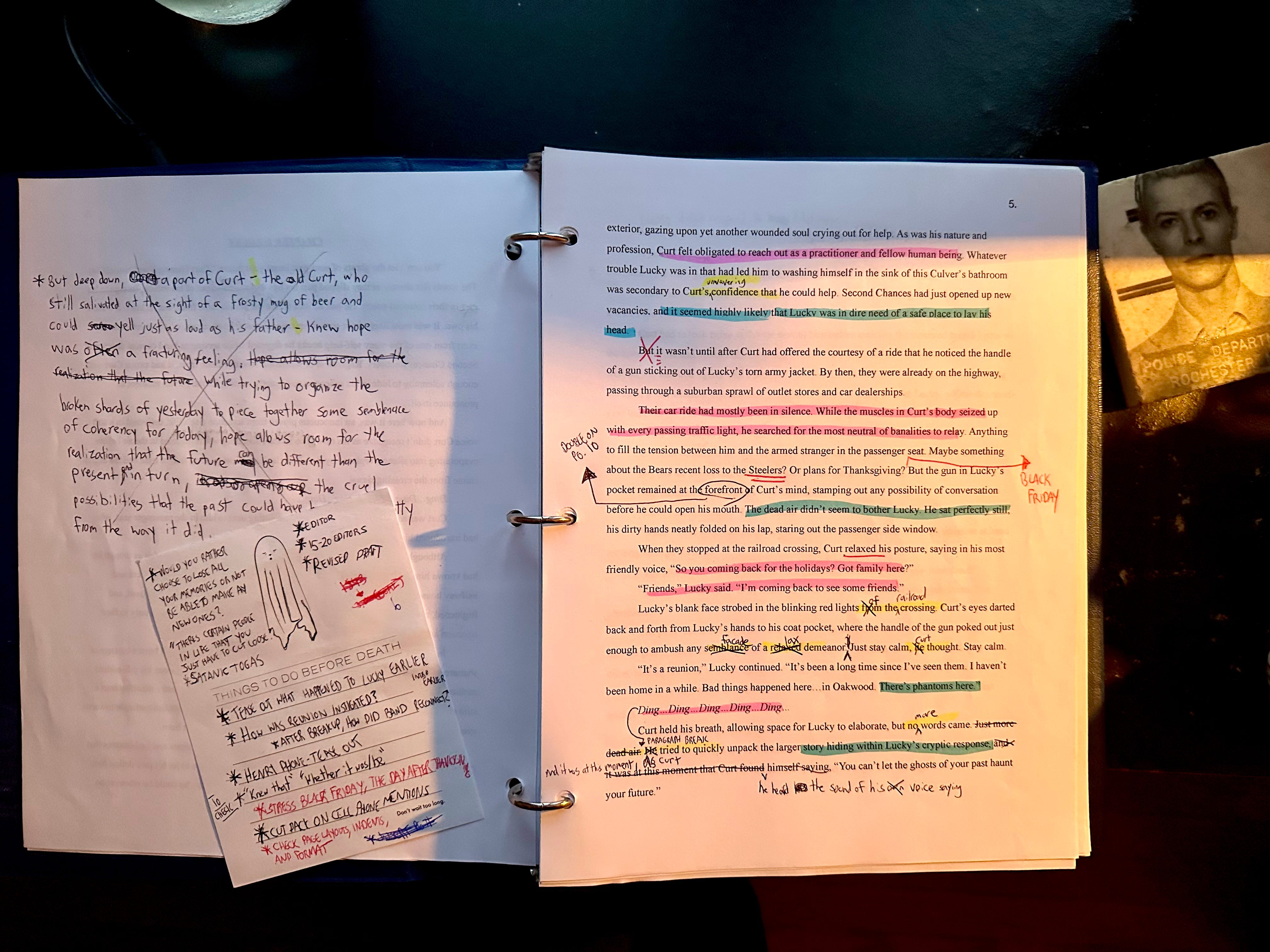
That brings me to today: after many years of writing and rewriting, sending out gazillions of queries, taking a plethora of meetings and calls, and circling back around on email chain after email chain—all the various impasses and standstills, hopes and frustrations—the manuscript remains unpublished. But it is finished.
I started this Substack as an outlet for my various pieces of writing that have no home: editorials and essays that don’t fit into my usual pieces for Aquarium Drunkard, short stories and bits of prose that don’t belong to a larger collection, etc. Since the manuscript has no literary residence outside of my computer’s hard drive, I thought I’d put a small dollop of it here.
When I consider the manuscript, I always return to this excerpt as its tonal nucleus. It encapsulates the mood and emotional resonance that I hope the full novel conveys to the reader. There’s also something inherently autumnal about it (at least in a Midwest sort of way), so it feels appropriate to post it during the chilly weeks of November, with the holiday season just around the corner.
For the sake of posting this excerpt as a standalone piece, I've revised and edited it so it can function outside of the novel's larger plot. If you read and dig, don't be shy! Maybe with your encouragement, I'll be inspired to post more or begin querying agents and publishing presses again. And if you hate it (and this long-winded post that prefaced it), that's all good, too. I tend to hate myself and my writing as well, so I will most likely agree with you.
As always, thank you for reading…
Mrs. Cozio came into Marro's Liquors every Monday at six p.m. on the dot. She always bought the same items: a bottle of Beefeaters gin and Mezzetta blu-cheese stuffed olives.
She wasn't much different from the other regular customers who frequented the liquor store, all of whom were longstanding citizens of Oakwood. Joe Marro knew them all, and from his post behind the counter, he'd greet them on a first-name basis. There was George Kilcullen, whose rumbling pick-up truck would roll into the lot every Tuesday and Friday to pick up a twenty-four case of Old Style and four packs of Camel Filters. Judy Pulchalski, who had been Joe's kindergarten teacher at Oakwood Elementary — known for riding her mountain bike to and from school daily with a glittery pink helmet — came in each Sunday to stock up on Diet Coke and scratch-off lottery tickets. At around closing time, Joe could count on Mary O'Neil to stop in for her daily bottle of cheap cabernet, her hands shaking as she handed over the crumpled dollar bills she made as tips at the Silverado Diner.
But unlike the usual patrons, who'd beeline straight towards their vices of choice, Mrs. Cozio took her time exploring the store with an aimless drift reserved for first-time customers. After shuffling through the door, stomping off snow or rain or whatever seasonal precipitation had fallen from the skies above Oakwood on that particular Monday, she'd meander up and down the aisles, inspecting the cases in the cooler and sunglasses on the rotating stand. Now and again, she'd pick up a bag of Goldfish or a can of tomato juice, slowly turning it over in her wrinkled hands before placing it back on the shelf.
Joe knew Mrs. Cozio was a widow. Her husband died from a heart attack when Joe was still in little league. It was rumored she suffered from Alzheimer's, and one need only observe her weekly visits to Marro's Liquors to verify this. But being an elderly widow with no children or immediate family, Joe wondered if her clockwork trips to the store were born out of loneliness. Or perhaps she was simply a creature of habit, embracing the comfort of familiarity and routines. A creature of habit himself, Joe sympathized with this.
As he watched her hobble towards the counter, Mezzetta blu-cheese stuffed olives in hand, Joe began reciting the regular pleasantries he and Mrs. Cozio shared weekly, dialogue from a script neither had written but repeated word for word as if every Monday was opening night. He'd ask Mrs. Cozio how she was, and she'd reply, "Oh, you know, hon, I'm the oldest I'll ever be, but I'll never be this young again." Then, without asking, Joe would grab her bottle of Beefeaters from the liquor shelf, asking, "How 'bout this weather we're having?" Their script would deviate here depending on the season, but it was a resolute question all midwesterners responded to. No matter the time of year, the weather was a charged topic. It was either too hot or too cold, too much snow or not enough rain.
After ringing her up, Mrs. Cozio would ask Joe how his parents were, and Joe would tell her they were doing great, even when they weren't. Then, as he shook out a plastic bag, Mrs. Cozio would point at the framed record hanging on the wall behind the counter, surrounded by autographed headshots of Mike Ditka and Sammy Sosa, asking, "How's the band? Are you still playing music?"
"Yeah, yeah, still gigging around," Joe would reply, always answering the second question but ignoring the first.
"That's good," Mrs. Cozio would say. "Keep at it!" And on this particular Monday, she added a new parting tag: "Don't forget about me when you're famous!"
The door closed behind Mrs. Cozio, sending a burst of blackened leaves onto the rubber floor mat. Joe watched her bumble across the parking lot, scratching at his greying beard. Like most physical changes brought on by aging, the coarse silver hairs sprouted from his face incrementally, and Joe was hardly aware of the slow-motion metamorphosis. But as he turned back to the record hanging on the wall, his skin dried out and his forehead lined with a mess of creases, he realized how old he'd become. The immediacy of his age subverted time, as if the twenty years between the record cover and Joe happened overnight.
Joe's father was responsible for displaying the record. He framed it himself, proudly hanging it amongst his shrine of notable Chicago athletes and local newspaper clippings ("Marro's Liquors: Still Going Strong After Forty Years!"). Although at first embarrassed, Joe didn't say anything. He knew it was a sign of affection from his father, and the gesture humbled Joe.
The record was a compilation called At The Turn Of The Century, and it was an object of pride for both father and son. For the old man, it was a finite sign of accomplishment, something he could point out to customers and say, "That's my Joe — right there on the cover, can you believe it?" For Joe, it confirmed what he always knew to be true: The Sleepy Bombs were overlooked in their time, and their material deserved a proper reevaluation.
At The Turn Of The Century was made up of garage-rock and punk bands from the Chicago suburbs of the late nineties and early aughts, many of whom Joe had personally known. The track-listing included songs that barely made it beyond local college radio — if they made it that far at all. These were recordings made in basements and bedrooms, burned onto blank CD-Rs to be handed out after shows at VFW halls and rec centers, and eventually lost in moves from dorm rooms to apartments.
The bands featured on the compilation (The Plugs from Glen Ellyn, Surround Sound from Geneva, Ray Peterson & The Deafkats from Schaumburg, The Starfish from Lombard, Captain Calendar from St. Charles, and Private Figures from Bensenville) existed in a vacuum of abandoned suburban history, scarcely remembered by the few who attended their shows or bought their silkscreened t-shirts. They were fossils without archaeologists, their short lifespans barely giving them enough time to move beyond the cul-de-sacs and backyards where they performed.
The album cover for At The Turn Of The Century featured a collage of promo photos from the bands on the compilation. Front and center — and much larger than the others — was a black-and-white snapshot of The Sleepy Bombs. Courtney Nicholson, the photographer for their high school newspaper, took the photo to accompany the article profiling the blossoming band in The Chargers' Gazette. The headline beneath it read: "Oakwood High Band Rocks Out After School, In Clubs."
The photo showed the band scattered across the bleachers next to the Oakwood Chargers’ football field, each member striking a different pose. Charlie and Joe sat on opposite sides, looking in different directions. Henry laid on his back to the far left, looking up at the sky. In the center, Lucky Anders sat cross-legged, peering directly into the camera lens.
Gazing at the record cover, Joe's eyes shifted from his eighteen-year-old face — beardless, grey-less, a thousand years younger — to Charlie Boulting, forever frozen on the Oakwood Charger's bleachers. Charlie still hadn't responded to Joe's texts or calls, nor had he mentioned his flight back for the reunion.
Over the years, Joe had found it harder and harder to get ahold of his best friend. On the rare occasions they did talk, Joe always instigated the conversation, and sometimes days and weeks would pass before Charlie responded. Their back and forth became increasingly stiff, void of the off-the-cuff silliness so much of their previous communication was built upon. Every time Joe tried to coax the old goofy banter out of Charlie, he'd cut the calls short because he had to do something else or had somewhere else to be. It left Joe with the nagging feeling that Charlie viewed their friendship as a chore. The fact that it'd been weeks since they last spoke only reassured Joe he'd become a low-priority checkmark on a list of monotonous errands for Charlie. The common ground they'd once shared had been repaved by life, by false starts and disappointments, and the thousands of miles between Joe’s life in Oakwood and Charlie’s life in Los Angeles were inconsequential compared to the millions of unshared moments during their time apart, the gap in relatability ever-increasing.
By the week of Thanksgiving, Joe was usually deep in discussions with Charlie about the annual reunion, now only a few days away. But Joe hadn't heard anything about the reunion from Charlie — or Henry, for that matter. He'd come to expect to hear nothing from Lucky.
As Joe studied the youthful faces of his old bandmates on the cover of At The Turn Of The Century, once his best friends and creative soulmates, a gloomy thought emerged: the reunion wasn't happening this year.
He hadn't considered it yet. It seemed impossible. The annual get-together was a constant in his life — in all of their lives — following the same reliable series of events year after year. Joe assumed the lack of communication stemmed from the event's sheer obviousness: of course the reunion was happening. But what if it wasn't? And what if it never happened again?
The tragic epiphany was interrupted by the sound of shattering glass, followed by a hoarse grumble: "Aw, shit! Damn it to hell!"
In the store's back corner, Ken Patterson stood in a puddle of malt liquor.
Joe grabbed the store broom and a roll of paper towels, calling out, "All good, Mr. Patterson, don't worry about it!"
"I'm sorry, Joe," Ken said, tip-toeing past shards of green glass. "Damn thing slipped right out of my hands. I'll pay for it."
"No big deal," Joe said, laying paper towels across the beer-soaked linoleum floor. "Shit happens."
"Ain't that the truth? And somehow, it always happens to me."
As Joe swept up the broken glass, Ken pulled at the bill of his Chicago Bears hat, profusely apologizing as he pulled dollar bills from his chain wallet.
"No worries," Joe repeated, guiding Ken towards the front counter. "I know you're good for it."
After ringing him up for his bottle of Olde English, Joe asked Ken if he needed a ride home. It was a courtesy Joe extended to all the old-timers who frequented the store, their eyes bloodshot and speech slurred.
"No, no, I'm fine," Ken assured him. "I walked over, you know, just a stone's throw away."
"Alright," Joe said. "Get home safely, Mr. Patterson. Happy Thanksgiving."
"Happy Thanksgiving, Joe," Ken said. "Tell your folks I say hi."
Ken Patterson lived in a single-story ranch house on Prairie Street, two blocks from Marro's Liquors. When Joe was a kid, the Patterson house was a must-stop Halloween destination. People as far as Elburn would make the pilgrimage to Oakwood to see the decorations displayed on the Patterson's front lawn: vampires in coffins, scarecrows on poles, and zombie limbs popping out from the flowerbed. As early as September, Ken could be found outside the ranch house on ladders and step stools, consulting hand-written diagrams with extension cords draped over his shoulders, laying the foundation for that year's homespun exhibition of terror. Amongst red lights and fogs of dry ice — which Ken synchronized with a loop of ominous castle sounds blaring from a pair of speakers cloaked in spider webs — a long line of trick-or-treaters would wait outside the front doors, bracing themselves for the ghoulish pageantry of the Patterson's residence. Joe and Charlie had once been amongst these trick-or-treaters, in awe of the sensationalism of the front lawn display. The Patterson's also gave out the best candy in Oakwood: king-sized Snickers and full packs of Fun Dip.
After Ken's wife and daughter died in a car crash coming back from Kenosha during a hailstorm, the extravagant Halloween decorations at 376 Prairie Street trickled down to a few styrofoam headstones and blinking orange lightbulbs. When Joe graduated from Oakwood High School, the Patterson's front lawn was barren come the thirty-first of October.
As Ken stumbled out of the store, sending in another gust of wind and leaves, Joe decided to close down early. Monday nights were slow anyway, and all the regulars had already stopped in. Before attending to the checklist of closing tasks — sweeping and dusting, restocking inventory, counting the drawer, taking out the trash, setting the security alarm — Joe removed At The Turn Of The Century from the wall.
He tore off a few more sheets from the roll of paper towels, spraying them with glass cleaner. He wiped down the frame, polishing the streaks and speckles of debris. Then, once he could see his grizzled reflection in the glass — superimposed on top of the youthful faces of The Sleepy Bombs — he carefully hung the record back up.
Joe walked to and from Marro's Liquors daily, taking the same route each time: West Avenue to Commonwealth, where he'd cut through Whitley Park to Prairie Street, passing by the drawn shades of the Patterson's residence. Then, he'd turn right onto Oakcrest, finally making a left onto Emery Lane, where his parent's house stood near the end of the block. Depending on his pace, it took about fifteen minutes to get home — a thousand and thirty-two steps from the parking lot of Marro's Liquors to his parent's driveway, which he'd counted numerous times.
On rare occasions, he'd cut through the high school football field, where a ripped panel of chainlink fence led to the train tracks that divided the field from Whitley Park. This shortcut usually shaved off about five minutes from his commute, but Joe wasn't in a hurry. He enjoyed taking his time getting home, breathing in the familiar streets of his childhood, passing the houses he once ding-dong-ditched and the yards he used to toilet-paper before homecoming. The quiet residential blocks of Oakwood were unchanging, and Joe sought comfort in their permanence. The faded stop signs and aluminum mailboxes, the spiderweb cracks in the pavement and dips in the streets, the brick ranch houses and towering Elm trees — they'd always been there and would always be there, from the beginning to the end of time.
Each block held secrets, stories you wouldn't find in the Oakwood Historical Registry but could overhear at barbecues and PTA meetings. These anecdotes were told in library whispers, existing in telephone wires and bonfire banter. Joe knew most of them, at least the greatest hits of Oakwood's clandestine past.
Joe turned onto Commonwealth, passing by what used to be Vincent Darnel's house, before Darnel slung a pair of sandbags over his shoulders and walked into Oakwood Creek, back when the water was high enough to engulf a six-foot tall man.
A block away was the three-bedroom ranch that once was home to the Cargill family. Mr. and Mrs. Cargill had lived with their adult son and daughter, both severely mentally handicapped. On a hot August evening, after Mr. Cargill received a stage four brain cancer diagnosis, he stopped at the liquor store and bought a bottle of Don Perignon. Joe was behind the counter that night, and he asked Mr. Cargill what he was celebrating. "New beginnings," Mr. Cargill had replied. After Mr. Cargill left Marro's Liquors, he returned home and murdered his family with a hunting rifle before pulling the trigger on himself.
Making his way onto Prairie, Joe glanced at the duplex on the corner. It was owned by the Livingstons, one of the oldest families in town. During The Great Depression, when Oakwood was still mostly farmland, the Livingstons bought up significant portions of Oakwood's real estate on the cheap, years before it would blossom into a desirable middle-class suburb. Although the Livingstons were far wealthier than most of Oakwood, they never flaunted it. They were well-mannered and respectful, embodying the archetype of the humbled midwesterner, quick to hold the door open for others at church on Sundays and let cars merge into their lane during rush-hour traffic, never sending entrees back to the kitchen even when their order was wrong. However small or large, the Livingstons preferred to endure hardships alone rather than make someone else do something they didn’t want to do for them. Like most midwesterners, they thought the greatest sin was being an inconvenience to others.
Whenever Joe rang up one of the Livingstons at the liquor store, it was always for the same cases of Old Style everyone else bought. They never took their change, instructing Joe to use it to bet on the Cubbies or Bulls or whatever Chicago team was playing that week. They cared about Oakwood and, through their charitable donations, were responsible for much of its preservation. Because of this, the commercial industrialization raiding the neighboring suburbs — creating carbon-copy blocks of outlet stores and restaurant chains — couldn’t infiltrate the microcosm of family-owned businesses in Oakwood.
Joe zipped up his hoodie, burying his hands in the warmth of his jeans pockets. The last gasping breaths of fall had chilled to a winter wind weeks ago, rustling the bare branches above the quiet streets. It would only get colder from here on out.
He crossed through a circle of red and green lights illuminating the Richardson's front yard. Like many Oakwood citizens, the Richardson's Christmas decorations sprouted up from their crawlspace to their lawn during the first week of November. By the end of the month, the whole block would be ornamented with plastic snowmen and draped in tinsel, automatic timers setting off stringed lights, blinking against the charcoal sky. Oakwood would soon be blanketed in snow, hushed and insulated as icicles dripped from gutters and chimneys puffed wisps of smoke. But for now, the brown and black remnants of autumn were beginning to give way to the silver and blues of winter, the morning dew exhibiting the first signs of frost as the nightly windchill dropped.
Joe loved these early winter weeks, when the days grew shorter and the nights colder. They brought a calm that muted the streets of Oakwood. It was as if the year knew it was dying, slowing down from the hectic pace of spring and summer to pause and reflect before coming to its inevitable end.
Joe could make out the outline of a Christmas tree through the bay window of his parent's house, not yet decorated. He peeked past the curtains, where he saw his father asleep in his recliner, the WGN nightly news on the television.
He continued down the driveway, looking up at his parent's bedroom window, where he knew his mother was already asleep, an opened book across her chest and a heating pad on her knees. She had always been an early riser, often up before the sun and fully dressed when The Oakwood Daily arrived at their doorstep.
Joe took out his keys, unlocking the side door to the garage. The utility light above the workbench was still on, casting shadows across the waxed surface of his father's Ford Galaxie 500, which hadn't left the garage since its yearly appearance at the Oakwood Fourth of July parade. Joe made his way over to the workbench, where a handful of tools surrounded a model train engine, soon to be looping around the base of his parent's Christmas tree. Joe clicked the light off, ascending the stairs to his room.
The second story was added to the Marro's garage when Joe was in junior high. The original intention was to have it be a workspace for his mother, whose interest in ceramics had been ignited after attending a pottery course at Oakwood's Parks & Recreational Center. It would be a short foray, lasting under a year and producing little more than a cupboard's worth of cracked bowls and teacups. When the kiln installation began, the downstairs bathroom in the house was already being converted into a darkroom for her newfound preoccupation with photography.
Joe assumed he inherited his creative genes from his mother, who grew up playing piano and studying poetry. She spent her life skipping across the surface of artistic disciplines, never settling on one but always committing herself to self-expression through art. Her tendency to abandon pursuits before any real premonitions of talent could develop made her a full-time hobbyist in the eyes of some, a failure in the eyes of others, or as she liked to put it, "a jack of all trades and a master of none."
After the pottery phase passed, Joe's father installed a skylight into the garage's second-floor ceiling and built a cyclorama, repurposing the space into a photography studio. And when photography morphed into oil painting, his father mounted a drying rack into the wall for canvases.
Towards the tail-end of the oil painting phase, Charlie got his first drum kit: a beat-up Pearl Forum with missing lugs. Naturally, Joe asked his parents if he could get a drum kit too. Although initially reluctant, the Marro's eventually offered to take Joe to Perry's Gear, a local used music store owned by Perry Gibbs, an old friend of Joe's father. "Just to look," his father told Joe before turning to his mother, saying, "I'm sure Perry will cut us a deal."
And Perry did cut them a deal, knocking off over a hundred dollars from the tag price — but not for a drum kit. Instead, Joe walked out the front doors with a black and white Danelectro and fifteen-watt Crate amplifier. It was a purchase that would forever change his life.
After weeks of hearing the screeching root notes to "Smoke On The Water," the Marro's suggested that Joe use the garage as his new practice space. His mother had recently taken to screenwriting, a pursuit that required little more than the Macintosh computer in the downstairs office, vacating the second-story addition on the garage. The easels and palettes were stored away to make way for amplifiers and guitar pedals. After Charlie brought his drum kit over, an unspoken agreement was reached amongst the Marro family: the upstairs garage was now Joe's music room.
Stepping inside, Joe kicked off his boots and turned on the floor lamp. Everything was as it was before he left for work: bed unmade, clothes scattered across the floor, the empty cans of Green River he'd been meaning to take down to the recycling for days still on top of his dresser. He crossed through the room, passing by the framed logo Lucky drew for The Sleepy Bombs the first time he came to the garage. It resembled a comic book explosion, done in pop-art style, bursting with yellow and orange lines erupting out of a jagged starburst. Near the center of the blast, in slanted capital letters that usually exclaimed an onomatopoeia ("BOOM! BAM!"), was "THE SLEEPY BOMBS."
Joe opened the mini-fridge, rummaging past half-eaten containers of hummus and crusty bottles of hot sauce. He popped off the bottle cap of his last Old Style, realizing he'd forgotten to grab another case at the store.
Sitting on his bed, Joe rechecked his phone: still no word from Charlie.
Joe looked across the room towards his overflowing record shelves, past where Charlie's drum kit and Henry's bass rig once stood. All that remained was Joe's Les Paul, leaning against a silver-plated Fender Deluxe Reverb amp that hadn't been turned on in months.
On top of the record shelf was a sealed bottle of Macallan eighteen-year sherry oak scotch. Drinking single-malt scotch was one of many traditions at the Black Friday reunion, and Joe took it upon himself to research and procure different bottles each year. He'd been saving the Macallan for the reunion, hoping to crack it open with a toast to old friends, amongst old friends. But finding himself alone, his last beer already finished, his messages and calls to Charlie unanswered, and thoughts of the reunion on Black Friday not happening, Joe picked up the bottle and ran his fingers across the embossed label.
The unofficial rule at the reunion was once the bottle was opened, it had to be finished in the same sitting. If Joe was to open the Macallan tonight, he intended to adhere to this rule out of respect, which meant he needed the proper soundtrack. He bent down, paging through the cubby holes of records lining the wall, debating what would best score his descent into sad-bastard drunkenness.
There were few things in Joe's life he could remember as well as where he found certain records, in certain record stores, in certain conditions. If given a year, even a fairly remote year when Joe had done little more than drift through days at the liquor store and squandered nights playing darts at The Oakwood Tap (there were many such years), he could remember the records he bought throughout those twelve months with absolute clarity: the creases on the jacket cover, the catalog numbers on the spine, the design of the gatefold — even the musty smell of the vinyl when he removed it from the sleeve. He could reel off endless details about the mom-and-pop bookstores and suburban garage sales where he purchased the records. He had an encyclopedic knowledge of not only the history and personnel on each album, but the origin stories of his specific copy.
The seed of Joe's obsession with records was planted at an early age. His Uncle Dominick, an insurance salesman who played pedal steel as a young man, had a library’s worth of vinyl records. On Sundays, the Marro family would go to Uncle Dominick's townhouse for Enteenmann's crumb cake and coffee after church. As the adults would sit in the kitchen, sipping instant coffee from Uncle Dominick's yellowed mugs, young Joe was allowed to peruse the shelves and select a record. Without knowing who the artists were or what the records sounded like, Joe would make his choices based on the covers: the spooky image of a witch in front of a farmhouse on Black Sabbath's Self-Titled or the glaring cow on Pink Floyd's Atom Heart Mother. He'd hand his selection to Uncle Dominick, who would hold the record as if it was an ancient jewel, delicately pulling the vinyl from behind the jacket — all of Uncle Dominick's records were in thick polyethylene sleeves — and placing it on the platter of his shiny Technics SL-1200 turntable.
Although Uncle Dominick lived in a one-bedroom ranch filled with second-hand furniture and minimal decorations, his hi-fi system was the exception to his thrifty lifestyle, rivaling men with far greater wealth but significantly less stereo knowledge. Two floor-standing Klipsch Heritage speakers towered over young Joe, placed on either side of an immaculately preserved Fisher 500 receiver and McIntosh pre-amps, tucked away into a custom-built console that looked like something from the control bay of a spaceship. After flipping the switches on all the units — the VU meters glowing shades of marigold — Uncle Dominick would hold a wood-handled stylus brush above the surface of the spinning record, following the grooves in the lacquer with the utmost care. The handling of the record and the ritual of prepping it for play informed Joe that these strange circular objects were sacred, as precious as the rarest of gemstones.
Then, after Uncle Dominick finished dialing in the EQ levels, he'd drop the needle, letting the soothing hiss of the record fill the room before Jon Bonham or Mark Knopfler exploded out of the speakers, crashing into Joe's impressionable ear drums.
When Dominick Marro died of liver failure at the age of fifty-two, Joe inherited his collection and meticulous care of records. By this point, Joe was a teenager, familiar with most of the classic rock titles in the collection. He began adding his own selections, painstakingly cleaning each record with distilled alcohol and micro-fiber cloths before and after each play.
Besides storage space, the quantity of the collection also introduced the problem of cataloging. Initially, Joe hadn't thought to shelf his records any which way, but as the collection grew, he knew some organizational scheme had to be employed. At first, he alphabetized, but after one too many times searching for records he filed improperly — The B-52s in the "B's" instead of the "T's," Roy Orbison in the "R's" instead of the "O's," and where to even begin with 96 Tears by ? and The Mysterians — he decided to implement a different approach.
His next attempt was to organize by genre, opening another Pandora's box. Did Lite Me Up by Herbie Hancock belong in "Jazz" or "Disco?" Was his extended-play twelve-inch single of Kiss by Prince better suited in "Funk/Soul" or "Pop/Rock?" A fellow record collector whom Joe often encountered at swap meets suggested cataloging chronologically by the record's release date, but this was even more convoluted than the options he'd already tried.
While navigating the infinite range of indexing possibilities, Joe noticed other collectors shelving their records in a way that reflected their personalities. His Uncle Dominick, for instance, organized his records by quality of condition, beginning with a sealed copy of Charlie Brown's Christmas by Vince Guaraldi and ending with a moderately worn (by Uncle Dominick's standards, though most would consider it near-mint) reissue of This Year's Model by Elvis Costello. Joe even encountered collectors who organized their collections by mood: records to play when feeling sad; records to play when feeling hopeful.
Joe eventually decided to catalog by favorite to least favorite. The bottom cubby holes on the other side of the wall were filled with records by Al Hirt and Barry Manilow, alongside a few Paula Abdul dub remixes. The top cubby hole, the one that the bottle of Macallan sat on, was the crème de la crème: The Stooges' Raw Power, The Velvet Underground's Loaded, The Clash's London Calling, Brian Eno's Here Come The Warm Jets, The Modern Lovers' Self Titled — all the touchstone records that informed The Sleepy Bombs' sound.
As Joe shuffled through the creased album jackets, recalling a lifetime's worth of memories scored by each seminal album in the top cubby hole, he stopped on his copy of At The Turn Of The Century.
He didn't know where to put the record with this new catalog system. Putting it amongst his favorite records felt pretentious, but his love for it — at least one song on it — was as strong as any of his other favorite records. It belonged in the prized top cubby-hole, its sentimentality eclipsing its prestige, as deserving as any of the other exemplary albums surrounding it.
Joe pulled it out, blowing on the lacquer and wiping down the surface. Holding it by the edges, he placed the vinyl on the turntable's platter, letting it spin and holding a stylus brush to the grooves. After undoing the latch on the tone-arm, he carefully moved the stylus above the opening track on Side A.
As Joe dropped the needle on At The Turn Of The Century, he thought about Mrs. Cozio and Ken Patterson and the grey hairs on his beard. He suddenly wanted to cry. In a moment, it seemed as though life had passed him by. Where did the time go? How did he become so old so quickly?
From the speakers, he heard Charlie's voice counting off the opening to "Can't Get Away (From Yesterday)" by The Sleepy Bombs, and a song Joe once wrote when life felt endless began to play.